




Why Is My Circuit Breaker Tripping? Causes Explained
July 22, 2026

A circuit breaker that trips once is doing exactly what it's designed to do — protecting your home's wiring from a dangerous overload. A breaker that trips repeatedly is telling you something is wrong, and the correct response is not to keep resetting it.
In OKC's current heat — with highs pushing 101°F and AC systems running 14 to 16 hours a day — tripping breakers are one of the most common electrical service calls of the summer. Some are simple overload situations with easy fixes. Others indicate a failing breaker, a wiring problem, or a developing fault that warrants same-day attention.
Here's how to tell the difference.
What a Circuit Breaker Actually Does
A circuit breaker is a safety device. It monitors the current flowing through a circuit and trips — cutting power — when that current exceeds the breaker's rated amperage. This prevents the wiring from carrying more current than it was designed to handle, which would generate dangerous heat inside your walls.
A 15-amp breaker protects a 15-amp circuit. A 20-amp breaker protects a 20-amp circuit. When the total draw of everything connected to a circuit exceeds the breaker's rating, the breaker trips. When a short circuit or ground fault creates a sudden surge of current, the breaker trips. When the breaker itself has degraded from age or heat damage, it may trip under loads it previously handled without issue.
The breaker is not the problem — it's the messenger. What tripped it is the problem.
The Three Types of Breaker Trips
Understanding which type of trip you're dealing with determines what to do next.
Overload trip. The circuit is carrying more current than the breaker's rating. Too many appliances, too many devices, or one large appliance drawing more than the circuit can handle. The breaker gets warm gradually and trips when it reaches its thermal limit. Overload trips often happen after extended runtime — the circuit handles the load fine for the first few hours, then trips once the breaker's thermal tolerance is exceeded.
Short circuit trip. A hot wire has contacted a neutral or ground wire somewhere in the circuit — inside a device, an outlet, or the wiring itself. Short circuits produce an immediate, instantaneous trip. The breaker trips the moment you plug in a device or flip a switch, not after running for a while. Short circuits are more serious than overloads and almost always require an electrician to locate and repair.
Ground fault trip. Similar to a short circuit, but the hot wire contacts a ground path — often through a person, water, or a grounded surface. GFCI outlets and breakers are designed to detect ground faults faster than a standard breaker. A ground fault trip in a bathroom, kitchen, garage, or outdoor circuit is a safety event, not just a nuisance.
Failing breaker trip. A breaker that trips under normal loads — loads it handled without issue for years — may have degraded internally. Breakers wear out, particularly in OKC's climate where summer heat pushes them to their limits for months at a time. A breaker that trips repeatedly at loads well below its rating, and where the circuit itself shows no obvious overload cause, is a candidate for replacement.
Why This Is Happening More This Week in OKC
Sustained extreme heat creates two specific electrical problems that combine this time of year.
Peak AC amperage draw, sustained for hours. Your AC system's compressor draws a significant surge of current at startup — often two to three times its rated running amperage for a fraction of a second. During normal operation, the compressor cycles on and off, so the circuit experiences these startup surges periodically throughout the day. During a sustained 101°F heat event, the compressor runs in long, continuous cycles with fewer off periods — but each restart still draws that startup surge. A breaker that was handling this cycle count fine in May is now handling it at maximum thermal stress for 14 to 16 hours a day.
Heat-degraded components reaching failure. Electrical components — breakers, wire insulation, connection points — degrade with heat exposure over time. A capacitor that was marginal in spring may fail in July. A breaker that was aging last summer may reach the end of its service life this week. A connection that was slightly loose may develop enough resistance under sustained heat to create a fault. The first 100°F week of summer is when marginal components that needed attention reveal themselves.
Which Breaker Is Tripping and Why It Matters
The AC breaker. The double-pole breaker for your air conditioning system — typically 30 to 50 amps — is the most common summer trip in OKC. If this is the breaker tripping, the cause is one of three things: the AC system is drawing more current than it should (indicating a developing compressor, motor, or capacitor problem), the breaker itself has degraded and is tripping at loads it should handle, or the circuit wiring has a developing fault. An HVAC technician can measure the actual amperage draw of the system and compare it to the nameplate rating. Above + Beyond's HVAC technicians carry clamp meters for exactly this diagnostic.
Do not repeatedly reset an AC breaker that keeps tripping. Resetting a breaker that trips on a short circuit or a compressor drawing locked-rotor amperage can cause serious damage — to the compressor, the wiring, or both.
Kitchen or bathroom breakers. These circuits carry multiple high-draw appliances and are common overload trips. In a heatwave, people use microwaves and toasters more to avoid heating the kitchen with the oven, which can push a circuit over its limit if two high-draw appliances run simultaneously. Check what's plugged in and operating on the circuit when it trips.
The refrigerator circuit. Refrigerators work harder in sustained heat — the compressor cycles more frequently when the ambient temperature is high. If your refrigerator shares a circuit with other appliances, this increased demand can push the circuit over its limit during peak afternoon hours.
Bedroom or living room breakers. Window AC units, space heaters being used in unusual configurations, or high-draw gaming and entertainment equipment can overload standard 15-amp bedroom circuits. If a circuit trip corresponds with a specific device being plugged in or switched on, that device's draw on the circuit is the likely cause.
The main breaker. A tripping main breaker — the large breaker at the top of your electrical panel that controls all circuits — indicates total household load exceeding the service rating, or a failing main breaker. If your main breaker trips, shut off major appliances before resetting it and call a licensed electrician. A tripping main breaker is not a routine reset situation.
What to Do When a Breaker Trips
Step 1: Don't immediately reset it. Go to the circuit and reduce the load first — unplug devices, turn off appliances, identify what was running when it tripped. If the circuit was clearly overloaded, reducing the load before resetting prevents an immediate re-trip.
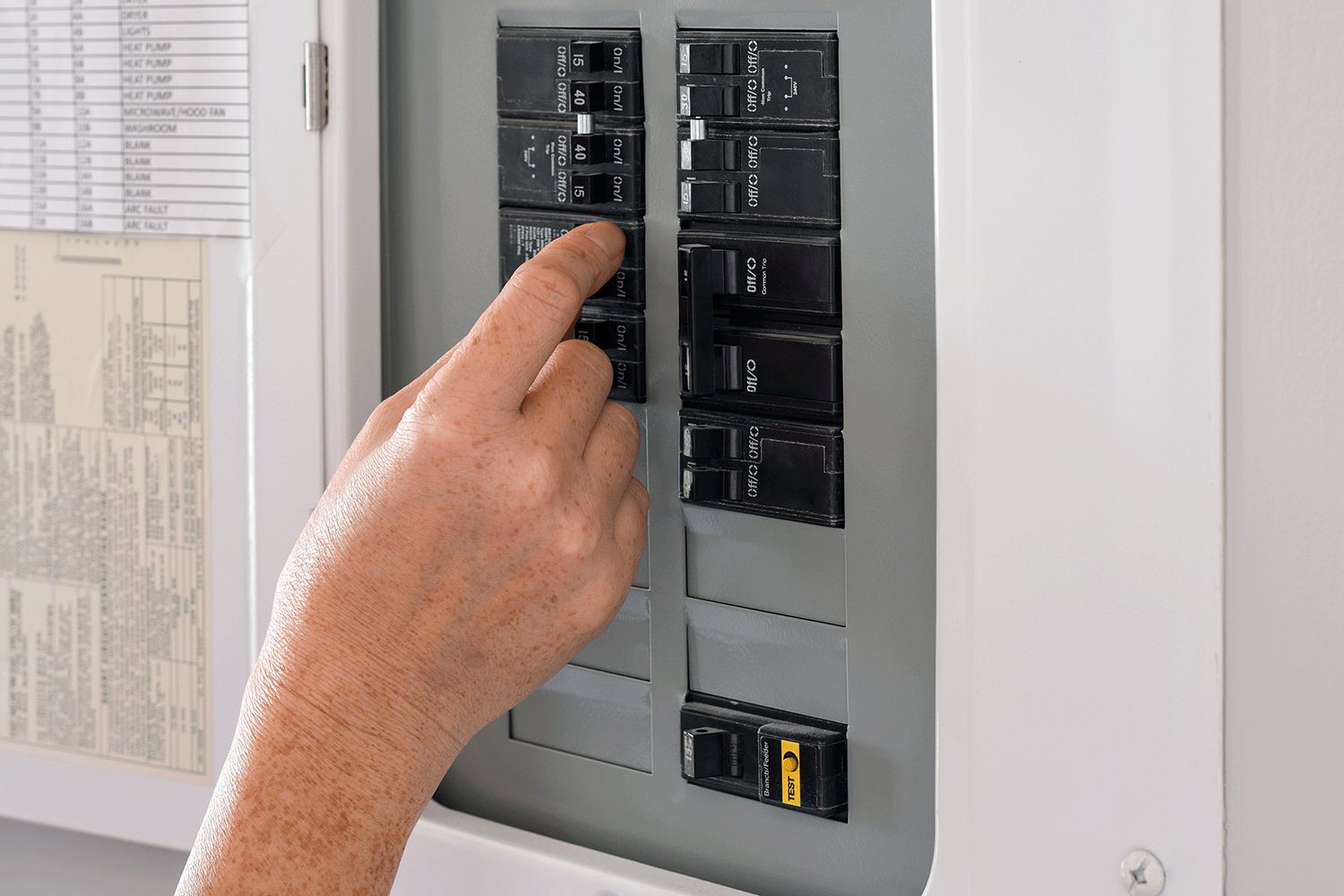
Step 2: Reset it once. Push the breaker firmly to the OFF position first — you should feel it click past the tripped middle position — then push it to ON. A properly functioning breaker will reset cleanly and stay on.
Step 3: If it trips again immediately after reset: Stop. Do not reset it again. An immediate re-trip indicates a short circuit or ground fault in the circuit wiring or a connected device — not an overload. This requires an electrician to diagnose. Continuing to reset a breaker on a short circuit risks wiring damage and fire.
Step 4: If it holds but trips again after a few minutes or hours under normal load: This is a pattern that warrants an electrician's assessment. Possible causes include a circuit that's chronically overloaded at normal usage levels, a breaker that's failing, or an intermittent fault developing in the wiring or a connected device.
Warning Signs That Require Same-Day Attention
Call a licensed electrician today — not this week, today — if any of these accompany a tripping breaker:
A burning smell from the panel, an outlet, or inside a wall. This indicates heat from a fault that is actively damaging wiring or connections and creating fire risk.
A breaker that feels hot to the touch at the panel. Breakers run warm under load, but a breaker that's genuinely hot — not just warm — indicates excessive resistance, which means heat in the wiring.
Visible scorching, burn marks, or melted plastic around an outlet or switch on the affected circuit. This indicates arcing has already occurred.
The breaker won't reset at all and stays in the middle tripped position after a firm reset attempt. This can indicate a locked-out fault condition or a breaker that has failed in a way that requires replacement.
Flickering lights on the affected circuit before or after the trip. Flickering combined with tripping indicates an intermittent fault rather than a simple overload.
Any breaker trip that was accompanied by a pop, a flash, or a spark from an outlet or device.
Older OKC Homes: Why This Happens More Often
A significant portion of OKC's housing stock — particularly in neighborhoods like Bethany, Del City, The Village, Midwest City, and parts of northwest OKC — was built between the 1950s and 1980s with electrical panels and wiring that were not designed for today's electrical loads.
A panel installed in 1965 was sized for a home that had one window AC unit, a refrigerator, a black-and-white television, and a few light fixtures. Today's homes on the same service run large central AC systems, multiple refrigerators, EV chargers, home offices, gaming systems, and high-draw kitchen appliances simultaneously.
Homes in this age range also commonly have 100-amp service where 150 or 200 amps is now standard, Federal Pacific or Zinsco brand panels with known reliability issues, aluminum branch circuit wiring in some cases, and breakers that have been in service for 40 or more years without replacement.
If you're in an older OKC home and experiencing repeated breaker trips across multiple circuits — not just one — an electrical panel assessment is worth scheduling. Above + Beyond's licensed electricians can evaluate your panel's capacity, condition, and code compliance and tell you honestly whether your current service is adequate for your home's actual load.
Frequently Asked Questions
Can I just replace the breaker myself? Technically, breaker replacement requires accessing the electrical panel, which contains live buses that remain energized even when individual breakers are off — the only way to de-energize the panel is to have the utility disconnect power at the meter. Working inside a live panel without proper training and equipment is genuinely dangerous. Breaker replacement is a licensed electrician's job, and it's a relatively fast and affordable service call when done professionally.
My AC breaker keeps tripping. Is it the AC or the breaker? It could be either. A clamp meter measurement of the AC system's actual amperage draw tells you definitively — if the system is drawing within its nameplate rating and the breaker trips anyway, the breaker is failing. If the system is drawing above its nameplate rating, the AC has a developing problem (usually a failing capacitor or compressor) that's causing excessive current draw. Above + Beyond's HVAC technicians measure amperage as a standard part of any diagnostic visit.
How long do circuit breakers last? Breakers are rated for a specific number of trip operations — typically around 1,000 trips for a standard residential breaker. A breaker that trips frequently accumulates these operations faster. Age also degrades breaker components — the thermal bimetallic strip that senses overloads and the contacts that interrupt the circuit both wear over time. Breakers in homes 30 or more years old that have never been replaced are worth evaluating.
My breaker trips only at night. Why? Nighttime tripping patterns often correlate with loads that run on timers — irrigation systems, pool pumps, water heaters on schedules — or with overnight AC behavior as the system runs longer cycles to maintain temperature in a house that has absorbed heat all day. Identify what's running on that circuit at the time of the trip and whether those loads combined exceed the breaker's rating.
Is a tripping breaker a fire hazard? A breaker that trips and stays off is doing its job — it's not a fire hazard in that moment; it's preventing one. A breaker that trips and is repeatedly reset without addressing the cause, or a breaker that has physically degraded and no longer interrupts current reliably, can contribute to fire risk. If a breaker trips repeatedly on a short circuit and you keep resetting it, the wiring absorbs the fault current each time. That accumulated damage is the fire risk.
Breaker Keeps Tripping in OKC? Call Above + Beyond.
Above + Beyond's licensed electricians serve Oklahoma City, Edmond, Yukon, Norman, Moore, Mustang, Guthrie, Midwest City, Del City, Bethany, Piedmont, Nichols Hills, The Village, Arcadia, Luther, and surrounding Central Oklahoma communities. We carry common breaker replacements on the truck and can diagnose the cause of a tripping breaker on the same visit.
Related Posts

Is a High-Efficiency Furnace Worth It in Oklahoma?
High efficiency furnace: is it worth it in Oklahoma? See comfort, payback, costs, and installation factors before you replace your furnace.


Heater Repair in Oklahoma City: Common Causes and Fixes
Heater repair in Oklahoma City: learn common causes, symptoms, and fixes, plus which repairs need testing before the next cold snap.

What Happens When You Ignore Gas Leak Precautions
Learn how to prevent a gas leak in your home and understand the serious risks of ignoring safety precautions. Stay safe and informed today!

You’ve Probably Heard About Our REPUTATION
We have maintained quite a reputation for our emergency repair service, affordable prices, open lines of communication and comprehensive services that are sure to go above and beyond your expectations.

Affordable Prices
We believe that everyone deserves access to high-quality solutions, which is why we offer specials that make our services more affordable than ever.

Open Lines of Communication
You can call us anytime to schedule an appointment or simply drop us a message on our website. We are always happy to hear from you!

Emergency Service
We offer evening and weekend availability to help provide prompt, efficient solutions for your service needs.

Comprehensive services
When you work with us, you can trust that you are receiving top-quality services from experienced professionals who take pride in their work.
EPA Certified Technicians
Above + Beyond and NATE only uses factory-trained, EPA certified technicians. Subcontractors are never used.
No Lemon Guarantee
Above + Beyond will replace your entire furnace unit for NO CHARGE if your heat exchanger fails within 10 years of the installation date. (Does not apply if regular maintenance is not completed.)
Punctual to Your Appointment
Your time matters. That's why every Above + Beyond appointment comes with a confirmed arrival window, a courtesy call when your technician is on the way, and a live tracking link so you're never left guessing.
We Stand Behind Our Work
Above + Beyond will provide 1 year labor warranties for parts installations and 2-year labor warranty on all equipment installations.

"We Are Very Happy With Above + Beyond!"
-Lucian D.
- Terri O'Bryant
- Todd Schug
- Winford willie



.avif)

.avif)
We Simplified Home Improvement Financing
- Several different loan types available.
- Financing available for most levels of credit.
- Options for deferred interest, deferred payments.


Serving Our Neighbors in Oklahoma City Since 2015
Ignoring plumbing, HVAC, or electrical issues in your home or business can lead to costly damage and safety hazards. That’s why our local experts are dedicated to keeping your property running smoothly with reliable residential and commercial services in Edmond,
Yukon, and the surrounding areas.
When you choose our certified contractors, you can expect us to deliver long-lasting results while prioritizing your safety from start to finish! From selecting a new appliance to repairing an existing system, we offer a variety of colors and styles from industry-leading brands to accommodate your unique needs and budget.
Our Service Areas
Installing a new AC unit? Frustrated with faulty outlets? Our contractors are available 24/7 for
all your plumbing, electrical, and HVAC needs in Oklahoma City!
.avif)


Take Advantage of
Our Offers + Save Today